
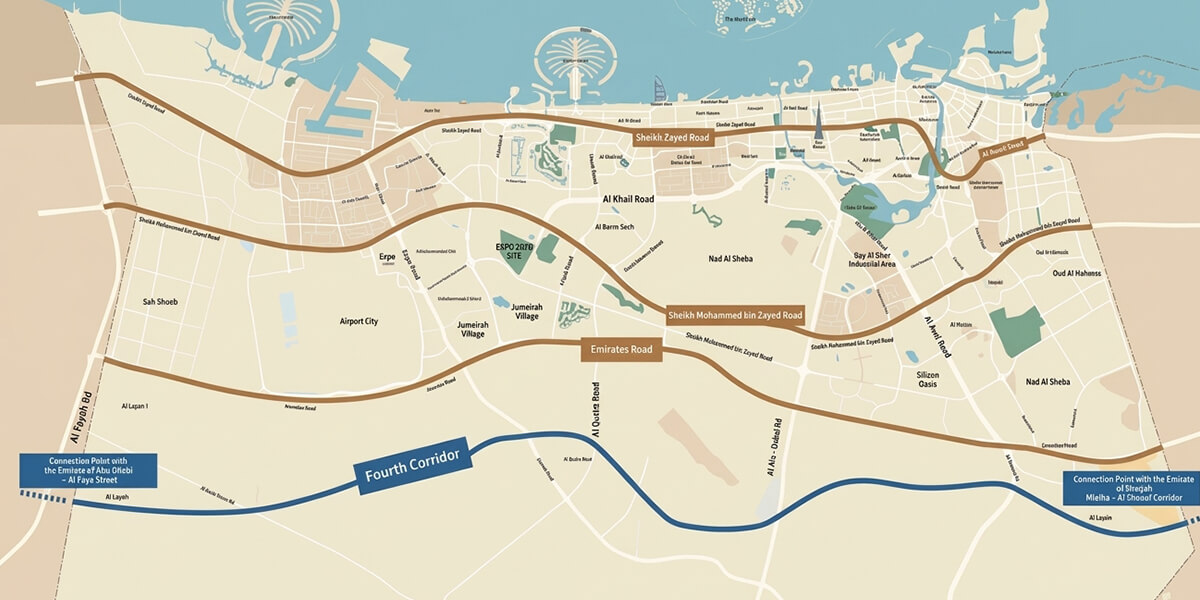
Approved by H.H. Sheikh Hamdan bin Mohammed bin Rashid Al Maktoum, Crown Prince of Dubai, the New Fourth Corridor Project represents one of the largest infrastructure developments undertaken by Dubai’s Roads and Transport Authority (RTA). Spanning approximately 80 kilometers, this 12-lane strategic arterial corridor connects Al Faya Road in Abu Dhabi directly to Al Shanouf Road in Sharjah through outer Dubai, drastically reshaping regional inter-emirate travel and freight logistics.
1. Key Specifications & Regional Connectivity
Designed to bypass heavily congested urban centers, the 12-lane highway (6 lanes in each direction) provides an integrated bypass route capable of handling up to 24,000 vehicles per hour in both directions. The corridor directly supports the UAE’s federal logistics strategy by integrating key transport hubs, industrial zones, and conservation areas.
- Inter-Emirate Linkage: Extends from Al Faya Road (Abu Dhabi) across Dubai to Al Shanouf Road (Sharjah).
- Strategic Hub Integration: Directly connects Al Maktoum International Airport (DWC), the Etihad Rail freight network, Al Marmoom Desert Conservation Reserve, and major residential communities.
- Engineering Marvels: The master project incorporates 72 bridges, 17 tunnels, and 45 stormwater drainage culverts across its entire length.
Project Summary: Dubai Fourth Corridor Expressway
| Total Length | 80 Kilometers |
| Lane Capacity | 12 Lanes Total (24,000 vehicles/hour combined capacity) |
| Phase 1 Investment | AED 3.5 Billion (30 km route from Al Shanouf to Dubai-Al Ain Road) |
| Phase 2 Scope | 50 km route from Dubai-Al Ain Road to Al Faya Road (Abu Dhabi) |
| Key Structures | 72 Bridges, 17 Tunnels, 45 Drainage Culverts |
2. Two-Phase Execution Plan
The project is being constructed in two synchronized phases to optimize traffic flow and logistics delivery across the Northern and Southern emirates:
Phase 1: Al Shanouf Road (Sharjah) to Dubai-Al Ain Road
Length: ~30 km | Cost: AED 3.5 Billion
Focuses on connecting Sharjah's Al Shanouf Road down to the Dubai-Al Ain Road. Includes 55km of surface roadwork, 2.5km of tunnels, and 21km of elevated bridges/ramps. Cuts commute time along this sector from 35 minutes to just 14 minutes (a 60% reduction) and serves approximately 600,000 residents.
Phase 2: Dubai-Al Ain Road to Al Faya Road (Abu Dhabi)
Length: ~50 km
Extends the highway southwestward toward Al Faya Road in Abu Dhabi. Incorporates 190km of surface roads, 3.5km of tunnels, and 157km of bridges and interchanges. Slashes travel duration from 50 minutes to 24 minutes (a 52% reduction) and is projected to serve over 3.1 million people.
3. Economic & Logistics Impact
By diverting heavy commercial vehicles and long-distance inter-emirate commuters away from inner-city arterial roads like Sheikh Zayed Road (E11) and Sheikh Mohammed Bin Zayed Road (E311), the Fourth Corridor significantly reduces regional congestion.

- Airport & Rail Connectivity: Accelerates freight movement between Al Maktoum International Airport and the Etihad Rail terminal network.
- Reduced Commute Times: Overall journey times across the outer corridor drop by up to 60%, unlocking faster transport times for logistics operators.
- Sustainability Integration: Incorporates advanced stormwater drainage systems (45 culverts) and eco-sensitive designs traversing the Al Marmoom Desert Conservation Reserve.